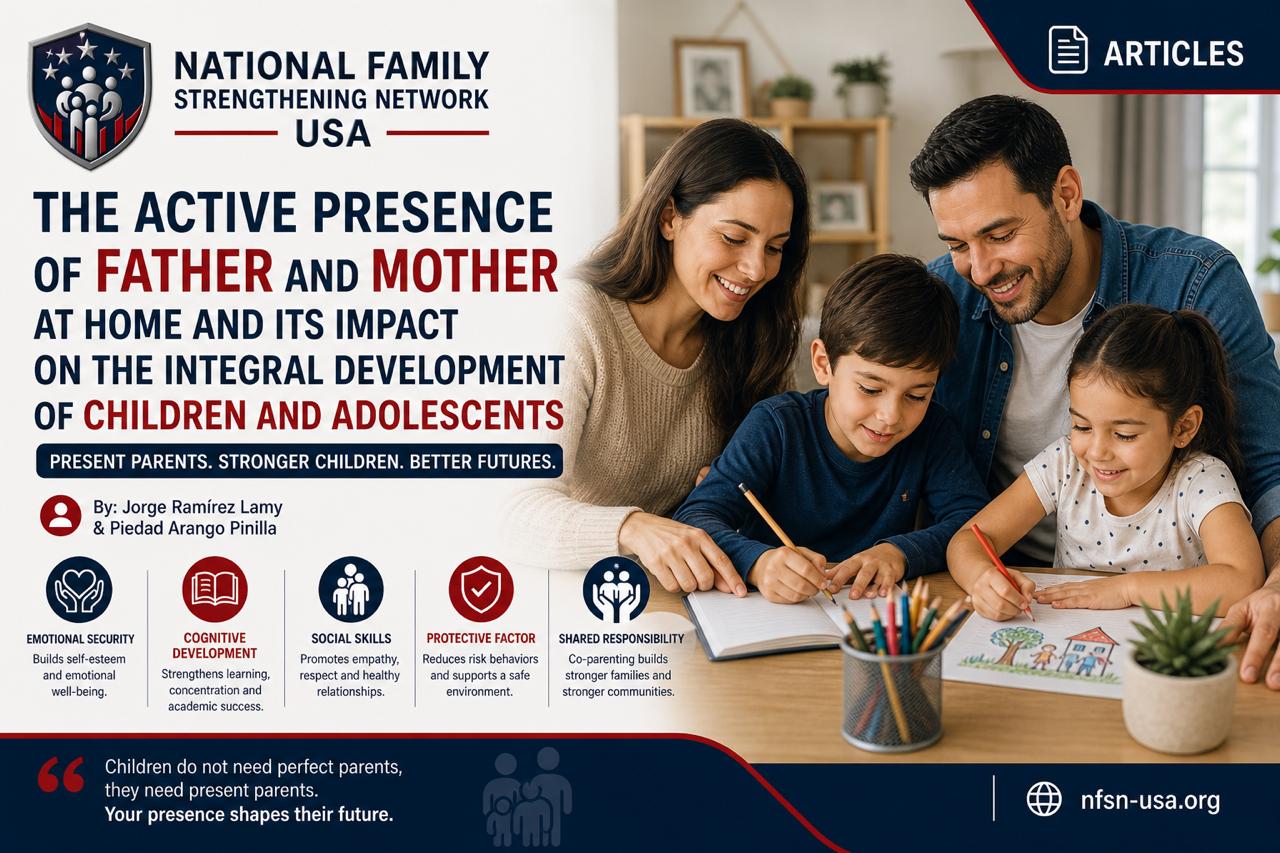
By: Jorge Ramírez Lamy & Piedad Arango Pinilla
Abstract
The family constitutes the first and most influential space of human socialization. Numerous studies in developmental psychology, sociology, and neuroscience have demonstrated that the active, stable, and emotionally available presence of both fathers and mothers in the home plays a decisive role in the cognitive, emotional, social, and behavioral development of children. This article analyzes, from an interdisciplinary and evidence-based perspective, the importance of joint parental involvement in the integral formation of children and adolescents, as well as the consequences associated with parental absence or fragmented participation. It concludes that co-responsible parenting not only strengthens individual child well-being but also acts as a key protective factor for social cohesion and the prevention of long-term psychosocial problems.
Keywords: parenting, child development, family, parental co-responsibility, child well-being.
- Introduction
The home is the first environment in which human beings learn to relate to themselves, to others, and to society. In this context, the role of fathers and mothers is not limited to material provision but includes emotional, educational, normative, and behavioral modeling functions. Scientific evidence consistently shows that the active presence of both parents—understood as emotional involvement, affective availability, and consistent participation in childrearing—constitutes an essential pillar for healthy child development (Lamb, 2010).
In contemporary societies marked by changes in family structures, long working hours, and socioeconomic pressures, strengthening the parental role has become a priority challenge for public policy and child protection systems.
- Theoretical Framework: Parenting as a Relational System
From attachment theory, Bowlby (1988) argues that early bonds with stable and sensitive parental figures create a secure base that allows children to explore the world, regulate emotions, and build healthy relationships. Both fathers and mothers fulfill complementary functions within this relational system, contributing interaction styles, emotional containment, and boundaries that enrich children’s psychosocial development.
Similarly, Bronfenbrenner’s (1979) ecological theory of human development emphasizes that the family constitutes the most influential microsystem in a child’s life, with the quality of parental interactions serving as a key predictor of positive or negative outcomes throughout the life course.
- Impact of Parental Presence on Emotional and Social Development
Multiple studies have shown that children who grow up with the active presence of both parents exhibit higher levels of self-esteem, better emotional regulation, and lower rates of anxiety and depression (Amato, 2014). Mothers often play a central role in early emotional containment, while fathers—traditionally associated with play, exploration, and social stimulation—contribute to the development of autonomy and social competence (Cabrera et al., 2018).
Consistent interaction with both parents allows children to internalize social norms, develop empathy, and acquire conflict-resolution skills, which are essential for healthy social adaptation.
- Influence on Cognitive Development and Academic Achievement
Parental presence also has a significant impact on cognitive development and academic performance. Longitudinal research indicates that children whose parents actively participate in their educational process—through school involvement, the establishment of routines, and clear expectations—demonstrate stronger language skills, greater concentration, and higher academic achievement (Hill & Tyson, 2009).
Joint involvement by fathers and mothers reinforces children’s perception of support, fosters intrinsic motivation, and reduces the likelihood of school dropout, particularly in socially vulnerable contexts.
- Consequences of Parental Absence or Weak Parental Roles
The physical or emotional absence of one or both parents has been associated with an increased risk of behavioral problems, emotional difficulties, and lower overall well-being during childhood and adolescence (McLanahan et al., 2013). These outcomes are not determined solely by family structure, but by the quality of attachment and consistency in parenting practices.
The lack of present parental figures may generate emotional voids, identity development challenges, and increased exposure to risk factors such as substance abuse, violence, and social exclusion.
- Implications for Intervention and Public Policy
Strengthening the role of fathers and mothers in the home should be a strategic priority in child and family policy. Parenting support programs, work–family balance initiatives, emotional education, and psychosocial support interventions have proven effective in improving parenting quality and preventing future problems (UNICEF, 2021).
Investing in strong families not only benefits children but also reduces social costs associated with health, justice, and social assistance systems, positioning family strengthening as a high-impact and sustainable strategy.
- Conclusions
Scientific evidence is clear: the active, conscious, and co-responsible presence of fathers and mothers in children’s lives is a determining factor in their integral development. Beyond social and cultural changes, the home remains the core space where the emotional, cognitive, and social foundations of human beings are formed.
Strengthening parenting is not solely an individual responsibility, but a collective commitment involving families, communities, and the State, aimed at building healthier, more equitable, and more resilient societies.
References (APA 7th Edition)
Amato, P. R. (2014). The consequences of divorce for adults and children: An update. Journal of Marriage and Family, 62(4), 1269–1287. https://doi.org/10.1111/j.1741-3737.2010.00790.x
Bowlby, J. (1988). A secure base: Parent-child attachment and healthy human development. Basic Books.
Bronfenbrenner, U. (1979). The ecology of human development: Experiments by nature and design. Harvard University Press.
Cabrera, N. J., Volling, B. L., & Barr, R. (2018). Fathers are parents, too! Widening the lens on parenting for children’s development. Child Development Perspectives, 12(3), 152–157. https://doi.org/10.1111/cdep.12275
Hill, N. E., & Tyson, D. F. (2009). Parental involvement in middle school: A meta-analytic assessment. Developmental Psychology, 45(3), 740–763. https://doi.org/10.1037/a0015362
Lamb, M. E. (2010). The role of the father in child development (5th ed.). Wiley.
McLanahan, S., Tach, L., & Schneider, D. (2013). The causal effects of father absence. Annual Review of Sociology, 39, 399–427. https://doi.org/10.1146/annurev-soc-071312-145704
UNICEF. (2021). Parenting in the time of COVID-19. https://www.unicef.org