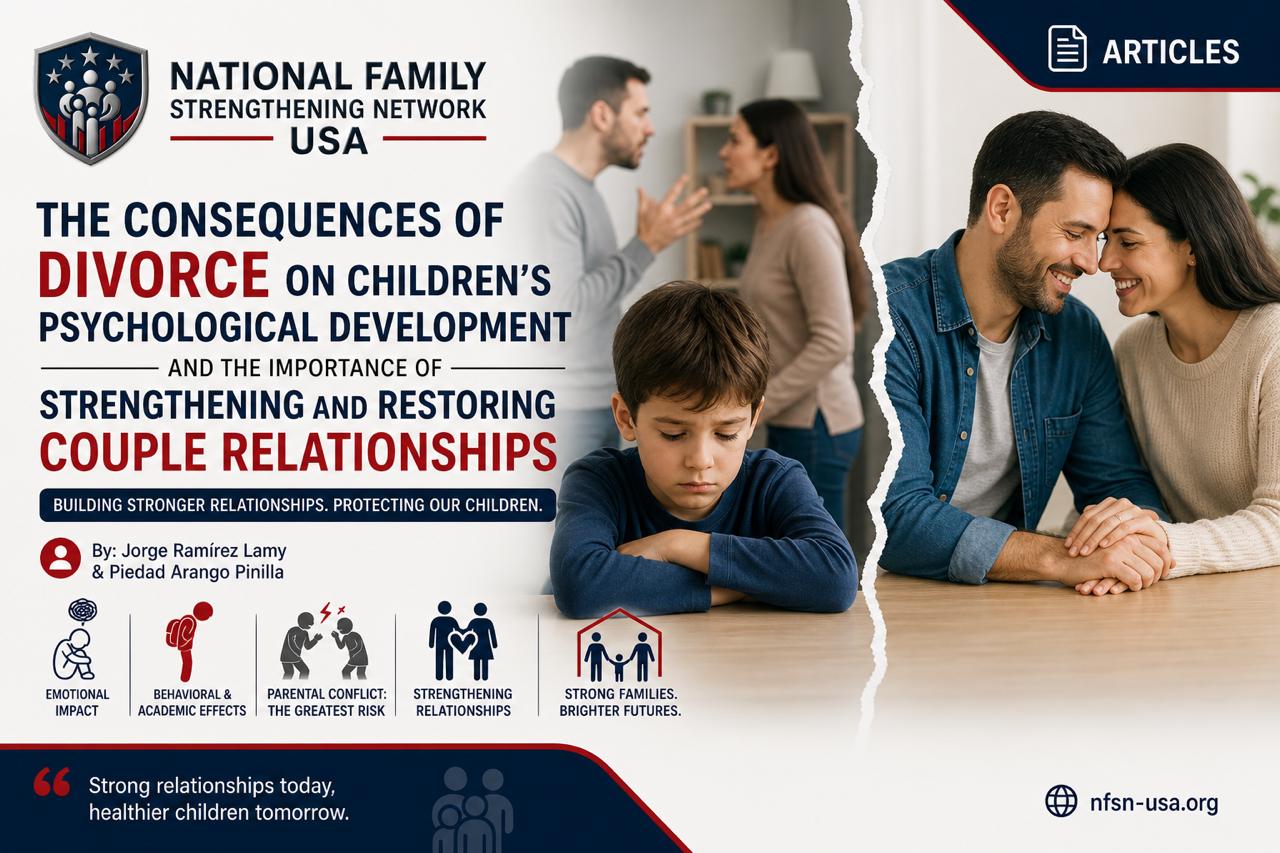
By: Jorge Ramírez Lamy & Piedad Arango Pinilla
Abstract
Divorce constitutes one of the most stressful family events for children and adolescents, with significant effects on their psychological, emotional, and social development. Although in certain contexts separation may be necessary to protect members of the household, empirical evidence demonstrates that divorce—especially when it occurs in environments of high conflict or without adequate support—increases the risk of emotional disturbances, behavioral difficulties, and long-term relational problems in children. This article analyzes the psychological consequences of divorce during childhood and adolescence and highlights the need to prioritize strategies aimed at strengthening, preventing, and restoring couple relationships as a socially responsible approach focused on child well-being. It concludes that investing in marital stability and constructive conflict resolution represents a key preventive strategy for mental health and social cohesion.
Keywords: divorce, psychological development, children, parental conflict, couple strengthening, family.
- Introduction
The family constitutes the primary system of emotional and psychological support during childhood. Within this system, the couple relationship between parents fulfills a key structural function for household stability. Divorce not only implies the dissolution of the marital bond, but also a profound reconfiguration of the emotional environment in which children develop.
Numerous studies have shown that children exposed to parental divorce exhibit, on average, higher levels of emotional stress, insecurity, and adjustment difficulties compared to those who grow up in stable households (Amato, 2014). While not all divorces generate the same effects, the evidence suggests that family dissolution should be addressed as a phenomenon of high psychological impact during childhood.
- Divorce as a Stressful Experience for Children
From a developmental psychology perspective, divorce is conceptualized as a stressful life event that can disrupt children’s attachment systems, sense of security, and predictability (Hetherington & Kelly, 2002). Parental separation is often accompanied by changes in routines, residence, economic dynamics, and parents’ emotional availability.
Children, particularly at early ages, may interpret divorce as a loss, abandonment, or even as a personal responsibility, increasing feelings of guilt, anxiety, and sadness. During adolescence, divorce can affect identity formation and perceptions of romantic relationships, generating skepticism or fear toward emotional commitment.
- Psychological Impact of Divorce During Childhood and Adolescence
Scientific literature indicates that children of divorced parents present higher rates of depressive symptoms, anxiety, behavioral problems, and academic difficulties, particularly when divorce occurs in contexts of chronic conflict (Kelly & Emery, 2003).
Additionally, research has identified a higher likelihood of risk behaviors during adolescence, such as substance use, early initiation of sexual activity, and difficulties in anger management (Amato & Keith, 1991). These effects are not inevitable, but they are statistically more frequent when adequate emotional containment mechanisms are absent.
- Parental Conflict as a More Harmful Factor Than Divorce Itself
Contemporary research emphasizes that it is not divorce alone, but rather unresolved parental conflict, that is especially damaging to children (Cummings & Davies, 2010). However, divorce rarely eliminates conflict; in many cases, it prolongs or intensifies it through legal disputes, custody tensions, and co-parenting difficulties.
For this reason, preventing divorce through the strengthening of couple relationships and the development of communication, negotiation, and conflict-resolution skills constitutes a more protective strategy for child well-being than normalizing relationship dissolution as an immediate solution.
- The Need to Strengthen and Restore Couple Relationships
Strengthening couple relationships does not imply denying the existence of conflict, but rather equipping couples with emotional and relational tools to manage disagreements constructively. Marital education programs, couples therapy, family mediation, and psychosocial support have proven effective in reducing conflict, improving marital satisfaction, and protecting children’s well-being (Gottman & Gottman, 2015).
From a preventive perspective, investing in the stability and restoration of couple relationships represents a direct action in favor of child mental health by preserving a safer, more predictable, and emotionally available family environment.
- Implications for Public Policy and Prevention Programs
Family-oriented public policies should prioritize preventive approaches that promote marital stability and early conflict resolution. The implementation of couple-strengthening programs, premarital counseling, support for families in crisis, and family mediation can significantly reduce divorce rates and their adverse effects on children (Waite & Gallagher, 2000).
From this perspective, avoiding unnecessary divorces and promoting relationship restoration is not an ideological stance, but rather an evidence-based strategy for protecting the psychological development of children and adolescents.
- Conclusions
Parental divorce constitutes a significant risk factor for children’s psychological development, particularly when it occurs in contexts of high conflict and without adequate support. Although separation may be necessary under certain circumstances, scientific evidence supports the need to prioritize divorce prevention through the strengthening and restoration of couple relationships.
Investing in healthy and functional couple relationships is ultimately a direct investment in child mental health, social cohesion, and intergenerational well-being. Strengthening the family from its relational core is one of the most effective strategies for building more stable, resilient, and humane societies.
References (APA 7th Edition)
Amato, P. R. (2014). The consequences of divorce for adults and children: An update. Journal of Marriage and Family, 62(4), 1269–1287. https://doi.org/10.1111/j.1741-3737.2010.00790.x
Amato, P. R., & Keith, B. (1991). Parental divorce and the well-being of children: A meta-analysis. Psychological Bulletin, 110(1), 26–46. https://doi.org/10.1037/0033-2909.110.1.26
Cummings, E. M., & Davies, P. T. (2010). Marital conflict and children: An emotional security perspective. Guilford Press.
Gottman, J. M., & Gottman, J. S. (2015). 10 principles for doing effective couples therapy. Norton.
Hetherington, E. M., & Kelly, J. (2002). For better or for worse: Divorce reconsidered. Norton.
Kelly, J. B., & Emery, R. E. (2003). Children’s adjustment following divorce: Risk and resilience perspectives. Family Relations, 52(4), 352–362. https://doi.org/10.1111/j.1741-3729.2003.00352.x
Waite, L. J., & Gallagher, M. (2000). The case for marriage: Why married people are happier, healthier, and better off financially. Doubleday.