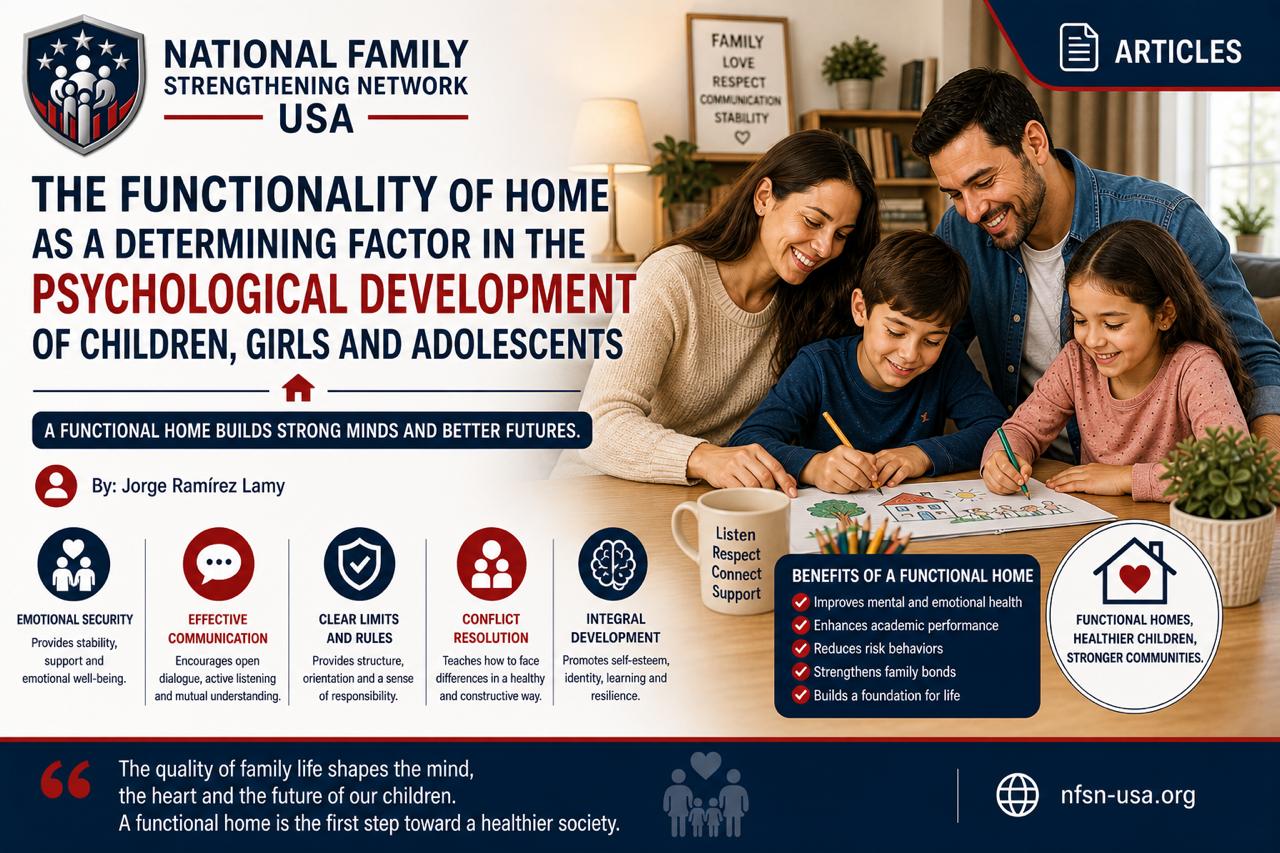
By: Jorge Ramírez Lamy & Piedad Arango Pinilla
Abstract
The home constitutes the primary environment in which the fundamental psychological processes of human beings are shaped. Beyond its formal structure, household functionality—understood as the quality of relationships, communication, emotional stability, and conflict-resolution capacity—plays a decisive role in the psychological development of children and adolescents. This article analyzes, from a psychological and psychosocial perspective grounded in empirical evidence, how a functional household acts as a protective factor for child and adolescent mental health, and how dysfunctional households increase the risk of emotional, behavioral, and relational disturbances. It concludes that promoting functional households is a key strategy for the early prevention of psychological problems and for building healthier societies.
Keywords: functional household, psychological development, child mental health, family, resilience.
- Introduction
Psychological development in children does not occur in isolation, but rather through constant interaction with their immediate environment. The home represents the first setting in which children and adolescents learn to interpret emotions, regulate behavior, establish bonds, and construct their identity. In this context, household functionality is particularly relevant, as it is internal dynamics—rather than family composition alone—that directly influence children’s mental health (Walsh, 2016).
A functional household does not imply the absence of conflict, but rather the family system’s capacity to address challenges adaptively, providing emotional security, normative consistency, and affective support.
- The Functional Household from a Family Psychology Perspective
From a systemic psychology perspective, the family is understood as a dynamic system in which each member’s behavior influences the functioning of the whole (Minuchin, 1974). A functional household is characterized by clear boundaries, defined roles, open communication, and flexibility to adapt to changes across the life cycle.
These characteristics allow children to develop in a predictable and safe environment, fostering healthy cognitive schemas, adequate self-esteem, and a positive perception of themselves and the world.
- Impact of a Functional Household on Emotional Health
Empirical evidence indicates that children who grow up in functional households exhibit lower levels of chronic stress, anxiety, and depressive symptoms (Repetti et al., 2002). Adult emotional availability, affective validation, and consistency in rules act as external emotional regulators that, over time, are internalized by the child.
In functional households, mistakes and conflicts are addressed as learning opportunities, strengthening frustration tolerance and emotional self-regulation.
- Identity Development and Self-Esteem in Functional Family Contexts
The construction of personal identity is deeply influenced by the emotional climate of the household. A family environment that provides acceptance, recognition, and consistent support facilitates the development of solid self-esteem and a coherent identity (Erikson, 1968).
Conversely, households characterized by disorganization, hostile communication, or emotional neglect may lead to identity confusion, insecurity, and increased dependence on external validation during adolescence.
- Psychological Consequences of Household Dysfunction
Dysfunctional households—characterized by violence, instability, poor communication, or inconsistent parental roles—are associated with a higher risk of behavioral disorders, academic difficulties, and long-term mental health problems (Evans et al., 2013).
Prolonged exposure to a dysfunctional family environment can alter children’s stress-response systems, affecting neuropsychological development and their capacity to establish healthy relationships in adulthood.
- Implications for Prevention and Early Intervention
Promoting functional households should occupy a central place in child mental health prevention strategies. Family strengthening programs, parental education, conflict mediation, and psychosocial support interventions have proven effective in improving household functioning and reducing psychological risk factors (Sanders et al., 2014).
Early intervention in family dynamics not only protects children’s emotional well-being but also reduces the need for more complex clinical interventions later in development.
- Conclusions
A functional household constitutes one of the most important protective factors for the healthy psychological development of children and adolescents. The quality of family relationships, emotional stability, and the ability to address conflicts adaptively are key elements that directly influence child mental health.
Strengthening household functionality is not solely a private responsibility, but a strategic social investment that positively impacts community cohesion, the prevention of psychosocial problems, and sustainable human development.
References (APA 7th Edition)
Erikson, E. H. (1968). Identity: Youth and crisis. Norton.
Evans, G. W., Li, D., & Whipple, S. S. (2013). Cumulative risk and child development. Psychological Bulletin, 139(6), 1342–1396. https://doi.org/10.1037/a0031808
Minuchin, S. (1974). Families and family therapy. Harvard University Press.
Repetti, R. L., Taylor, S. E., & Seeman, T. E. (2002). Risky families: Family social environments and the mental and physical health of offspring. Psychological Bulletin, 128(2), 330–366. https://doi.org/10.1037/0033-2909.128.2.330
Sanders, M. R., Kirby, J. N., Tellegen, C. L., & Day, J. J. (2014). The Triple P-Positive Parenting Program: A systematic review and meta-analysis. Clinical Psychology Review, 34(4), 337–357. https://doi.org/10.1016/j.cpr.2014.04.003
Walsh, F. (2016). Strengthening family resilience (3rd ed.). Guilford Press.