
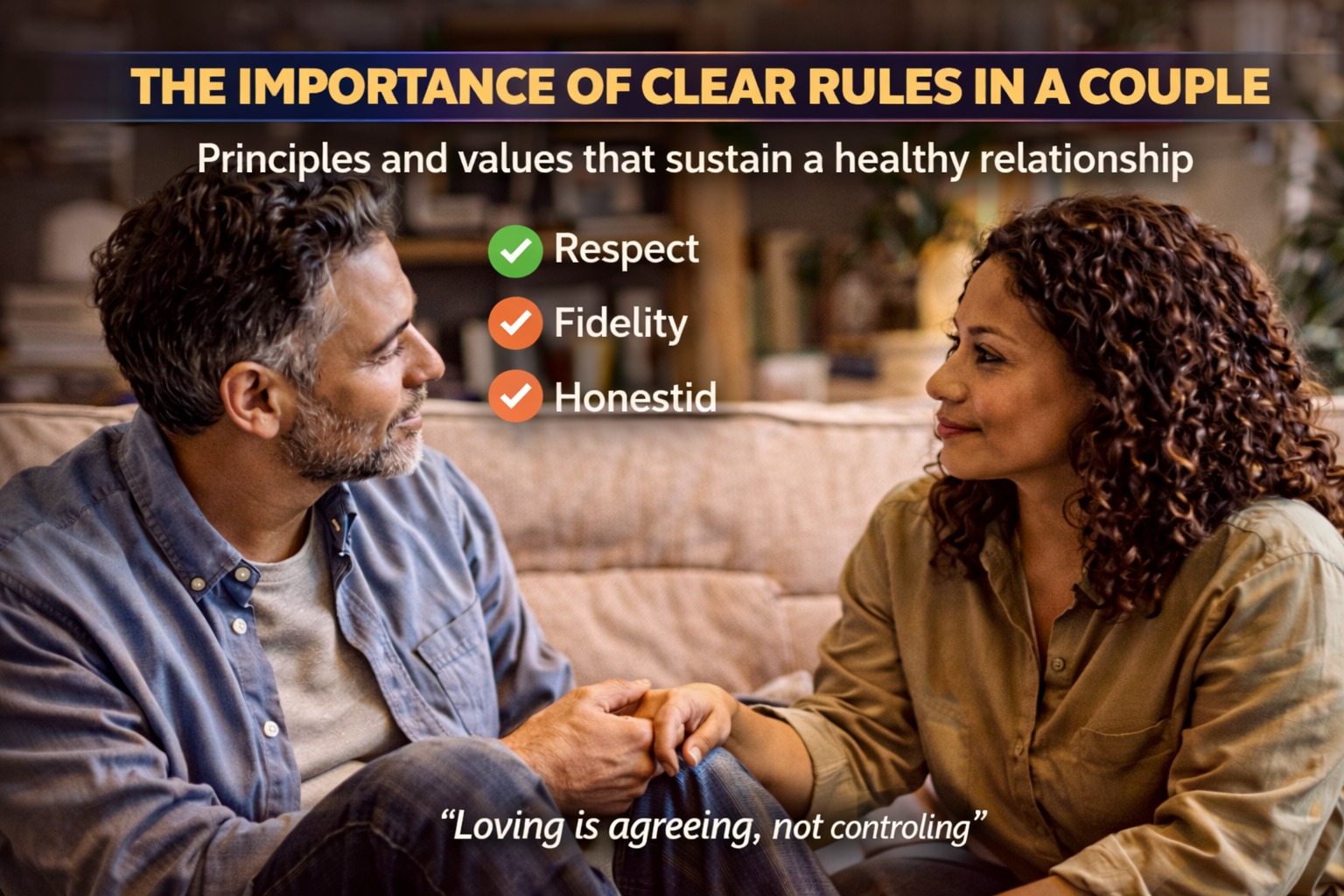
THE IMPORTANCE OF CLEAR RULES IN A COUPLE:
PRINCIPLES AND VALUES THAT SUSTAIN A HEALTHY RELATIONSHIP
By: Piedad Arango Pinilla
In every healthy couple relationship, there are rules, even when they are not always explicitly stated. These rules should not be understood as impositions, controls, or limitations on personal freedom, but rather as conscious agreements that protect the relationship, strengthen trust, and bring order to daily coexistence.
When rules emerge from shared principles and values, they become a framework of emotional security that allows the relationship to grow in a stable, respectful, and coherent way.
Clear rules do not mean rigidity, but coherence
A couple without clear rules often operates in ambiguity: what is acceptable today may no longer be tomorrow; what is normal for one partner may be offensive to the other. This lack of clarity generates unnecessary conflict, frustration, and emotional exhaustion.
Well-established rules provide:
- Emotional order
- Realistic expectations
- Security in coexistence
- Prevention of avoidable conflicts
The goal is not to control the other person, but to protect the bond.
The true origin of rules: principles and values
Healthy rules do not arise from fear, unresolved pain from the past, or poorly processed traumatic experiences. They arise from solid values that both partners recognize as fundamental to their shared life project.
Some values that commonly give rise to healthy rules in a couple include:
- Respect
- Fidelity
- Honesty
- Loyalty
- Emotional responsibility
- Commitment
- Personal and mutual dignity
When a rule is grounded in values, it is not experienced as a burden, but as an expression of love and maturity.
Respect as the central axis of every rule
Every valid rule in a couple relationship aims to protect mutual respect. Respect is reflected in how partners speak, act, make decisions, and handle disagreements.
Examples of respect-based rules include:
- Not humiliating or demeaning each other during disagreements
- Not exposing or ridiculing one another in front of others
- Respecting agreements of emotional confidentiality
- Caring for both verbal and nonverbal language
These rules do not limit expression; they elevate it.
Clarity builds trust
Trust does not arise from love alone, but from consistency between words and actions. Clear rules eliminate uncertainty and prevent subjective interpretations that often lead to conflict.
When both partners know what is expected, what is allowed, and what is not, the relationship becomes more emotionally stable and predictable, strengthening the bond.
Rules should be discussed, not imposed
Healthy rules are built through dialogue, agreement, and mutual understanding. Imposing rules without consensus often generates resistance and resentment.
A mature conversation about rules involves:
- Listening to the other’s perspective
- Explaining the purpose behind each agreement
- Aligning rules with the couple’s shared vision
- Revisiting rules when necessary
Rules may evolve over time, but values must remain firm.
Freedom with responsibility
A relationship grounded in principles understands that personal freedom does not disappear in a partnership, but it is exercised with emotional responsibility. Freedom without rules leads to chaos; rules without freedom lead to oppression.
Balance is found in agreements that protect individuality without putting the relationship at risk.
The impact of rules on the home and family
When a couple establishes clear rules and respects them, an emotionally stable environment is created that positively impacts the entire household. In families with children, these rules become a model of coexistence, respect, and emotional order.
Children learn more from what they observe than from what they are told.
Conclusion
Clear rules in a couple relationship are not an obstacle to love, but a structure that sustains it. When grounded in principles and values, they strengthen the relationship, prevent conflict, and allow couples to build a solid and coherent life project.
At the National Family Strengthening Network – USA (NFSN-USA), we believe that couples who dialogue, agree, and respect value-based rules build healthier relationships, more stable homes, and stronger societies.
